Why windows matter more than walls
External walls in Polish residential construction — whether brick, aerated concrete, or prefabricated panel — typically achieve 45–55 dB of weighted sound reduction index (Rw). Standard single-glazed windows from the communist-era large panel buildings (wielka płyta) often sit at 20–25 dB. Even in newer construction, a poorly fitted double-glazed unit may only reach 28–32 dB.
When multiple building elements are combined, the composite insulation is dominated by the weakest component. A room surrounded by 50 dB walls but with a 28 dB window achieves roughly 28–30 dB of total insulation — limited almost entirely by the glass.
The Rw classification system
Window acoustic performance in Poland is assessed using the weighted sound reduction index Rw, measured according to Polish Standard PN-EN ISO 140-3 and rated per PN-EN ISO 717-1. Manufacturers must declare the Rw value along with the correction terms C (for traffic noise) and Ctr (for urban traffic noise). The composite value Rw + Ctr is what matters most for urban apartments near roads.
Polish building regulations (Warunki Techniczne, Dz.U. 2002 nr 75 poz. 690, as amended) require that the minimum acoustic performance of external partitions — including windows — meets the indoor sound level targets in PN-87/B-02151/02. In practice, new windows in urban residential buildings are expected to achieve at least Rw ≥ 33 dB.
Glazing types and their performance
The type and configuration of the glazing unit has the largest single effect on acoustic performance. Key variables are glass thickness, the number of panes, the gap between panes, and whether the gap contains air or an inert gas.
| Glazing configuration | Typical Rw range (dB) | Common application |
|---|---|---|
| Single pane, 4 mm | 20–23 | Legacy buildings, unrestored stock |
| Standard double glazing 4-16-4 | 28–32 | Most post-1995 new build |
| Acoustic double glazing (e.g. 6-12-6) | 33–38 | Urban apartments, road-facing facades |
| Acoustic laminated inner pane (e.g. 4+4-14-6) | 38–44 | Motorway or railway-adjacent buildings |
| Triple glazing with acoustic interlayer | 42–48 | High-exposure facades, specialist installation |
Asymmetric glazing — using panes of different thickness — significantly reduces the coincidence dip, a resonance effect that degrades mid-frequency performance. For example, 4+6 laminated glass outperforms 6+6 at the frequencies most associated with road traffic noise (250–1000 Hz).
Frame materials
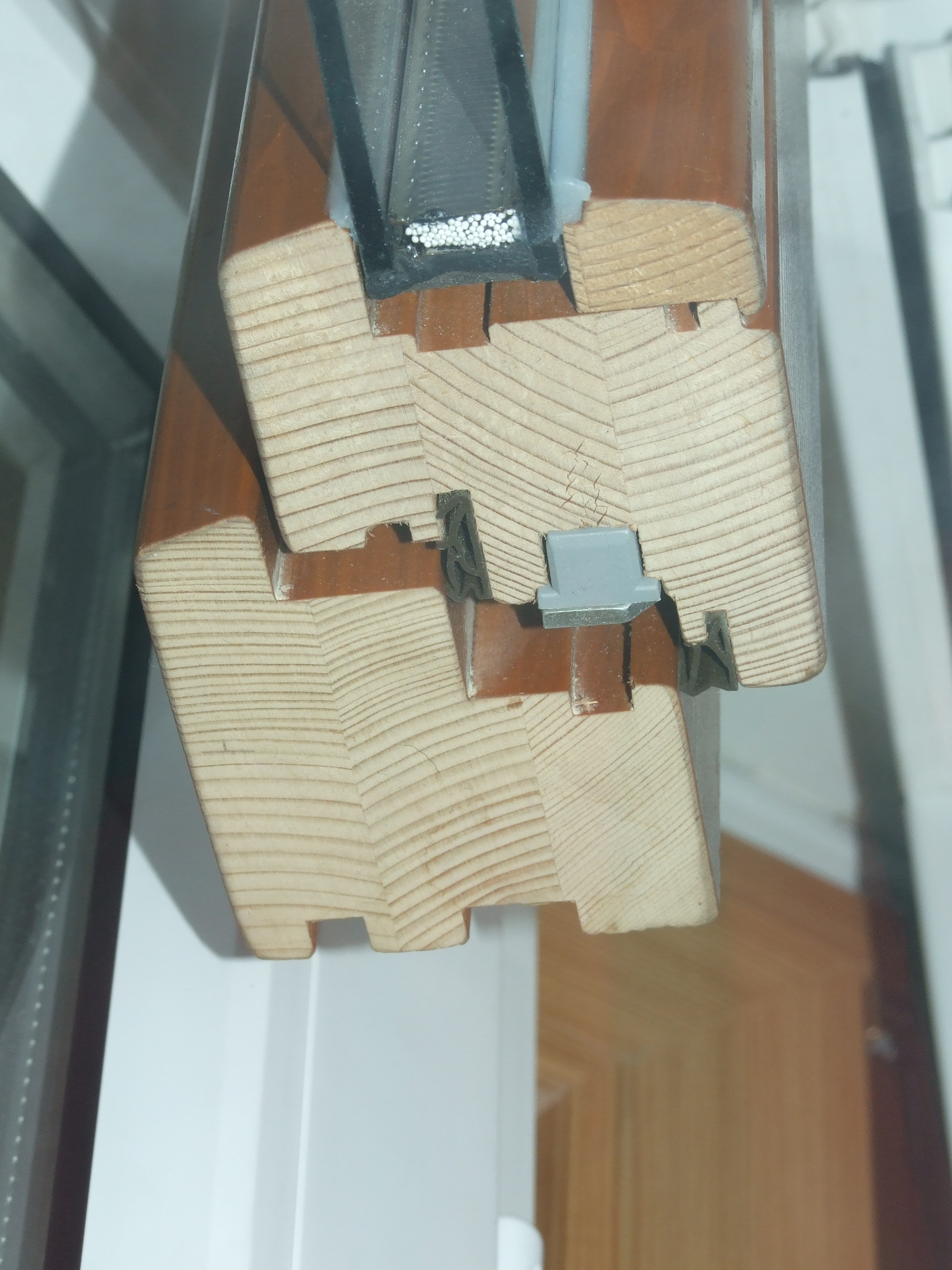
The frame contributes less to overall acoustic performance than the glazing, but it matters for air-tightness. Frames can be made from PVC, timber, aluminium, or composite sections.
PVC frames
PVC is the most common choice in Polish residential refurbishment. Multi-chamber PVC profiles — six or more chambers — provide good air-tightness and adequate acoustic sealing when fitted with compression seals on all three sides (sash, frame, and transom). Some mid-range PVC windows include acoustic gaskets as standard.
Timber frames
Well-maintained timber frames with compression seals perform comparably to PVC in acoustic terms. The primary risk with timber is dimensional change with humidity — gaps can open and close seasonally, degrading air-tightness over time. Systems with engineered timber (glued laminated cores) are more dimensionally stable.
Aluminium frames
Aluminium profiles with thermal breaks are structurally rigid but conduct sound more readily than PVC or timber if the thermal break bridge is not designed with acoustic isolation in mind. High-specification aluminium systems used in commercial buildings often include additional acoustic sealing details not present in residential-grade products.
Installation quality
A correctly specified window can lose several decibels of acoustic performance if installed poorly. Common installation problems include:
- Gaps between the window frame and the reveal, filled only with expanding polyurethane foam (which is not acoustically dense).
- Missing or degraded perimeter seals on the interior side.
- Trickle ventilators and ventilation slots left open — each can admit significant noise.
- Incorrect compression on the sash seals due to maladjusted hinges.
Polish installers working on noise-sensitive projects should follow the three-layer installation system: vapour-permeable tape on the outside, polyurethane foam in the middle, and vapour-barrier tape on the inside. This approach also meets the Warunki Techniczne requirements for moisture management.
What residents can check
Before replacing or specifying windows, residents can check the following:
- Ask the manufacturer or supplier for the declared Rw + Ctr value from a test report, not just the Rw value.
- Verify that the test report was issued by an accredited laboratory (in Poland, the ITB — Building Research Institute in Warsaw — is a major provider of such certifications).
- Check whether the local MPZP or building permit requires a minimum acoustic class for your facade.
- Ask the installer what perimeter sealing system will be used and whether acoustic-grade sealants are included.
- Inspect existing windows for seal condition, hinge adjustment, and whether any ventilation slots or trickle vents are present.
Realistic improvement expectations
Replacing a standard 28 dB double-glazed window with an acoustic 38 dB unit should reduce perceived noise by a moderate amount — roughly half as loud to most listeners, since each 10 dB reduction corresponds to approximately a halving of perceived loudness. However, if other building elements (such as gaps around pipes or poorly sealed roller blind boxes) transmit noise at lower levels, the net benefit of better glass alone may be limited.
For apartments with persistent noise problems, an acoustic assessment by a certified acoustician — before specifying any works — is a useful step. ITB (itb.pl) and various private acoustic consultancies in Poland offer residential assessments.